Where should you advertise as an affiliate in 2026? The direct answer: Google Ads Search is still the highest purchase-intent channel, Meta (Facebook and Instagram) dominates discovery and volume, TikTok grows with younger audiences, and a new entrant — OpenAI Ads, inside ChatGPT — is starting to capture decisions that used to happen in the search bar. There's no single channel: there's the right channel for your offer, your funnel and your budget. This guide compares the options and shows what they all have in common.
Paid traffic channel: a platform where you buy clicks or impressions to send visitors to your landing page. Each channel catches the person at a different stage — actively searching (intent), browsing (discovery), or talking to an AI (assisted decision).
Google Ads: the highest-intent channel
When someone searches "best English course" or "sleep supplement that works", they're close to a decision. That's why Search has historically been the go-to channel for affiliates promoting digital products and nutraceuticals: you pay per click from people who already showed interest. The challenge is margin — CPC has risen, and only campaigns with a high Quality Score and conversion tracking keep CPA viable.
Meta Ads: discovery and volume
Facebook and Instagram work on the opposite logic: the person isn't searching for your product, they're browsing. You interrupt with a strong creative and targeting by interest and behavior. It's excellent for generating volume, testing angles and scaling visual offers — but it demands constant creative and a presell that holds cold traffic arriving with no prior intent.
TikTok and others: younger audiences, native formats
TikTok Ads captures younger attention with native video and can make the right offer go viral, but it usually brings colder audiences and a lower ticket. It's worth it as a testing and diversification channel, rarely as your only base. As on Meta, the video and the landing page carry the result.
OpenAI Ads: advertising inside ChatGPT
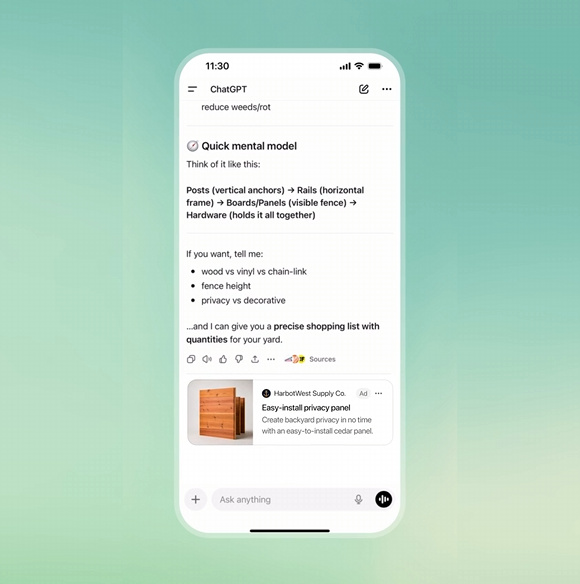
The 2026 entrant is OpenAI Ads — the advertising platform inside ChatGPT. The thesis: part of the buying decisions that used to start on Google now start in a conversation with an AI, where the person describes context in far more detail ("I need a gift under $50 for someone who loves cooking"). That promises more relevant ads shown at the moment of decision. It's promising and worth getting in early — but it's still experimental: pricing, availability by country and affiliate policies aren't clear at launch.
The affiliate's most expensive mistake isn't picking the wrong channel — it's pointing the ad straight at the affiliate link or at a slow page. Whatever the channel, a deceptive destination gets the account banned and a slow WordPress presell burns budget. Infrastructure comes before the platform choice.
How to pick the right channel for your offer
Instead of asking "what's the best channel", ask "where is my offer's intent". A practical roadmap:
- Offer people actively search for (a course, a solution to a problem) → start with Google Ads Search
- Visual or impulse offer (physical product, transformation) → Meta Ads for discovery and volume
- Younger audience and video format → TikTok as a test and diversification
- Want to be on the frontier and test AI-assisted decisions → OpenAI Ads with a small budget
- In every case → own presell, trusted domain and sales tracking live before you scale
What every channel has in common (and where AdsX fits)
Notice the pattern: on any channel, the ad is just the front door. What converts is what comes after the click — the landing page, the speed, the domain and the tracking that shows what drove the sale. Switching channels doesn't change that foundation; it only changes where the click comes from. That's why the smart affiliate invests in structure first and only then picks where to buy traffic.
AdsX was built exactly for that foundation — and it's channel-agnostic. You set it up once and use it on any platform: Google today, ChatGPT tomorrow.
- AdsPages — AI presell (review, quiz, cookie, ghost…), no WordPress
- AdsDomains — custom domain with SSL and DNS in one click
- AdsHosting — fast hosting, antibot and strong Core Web Vitals
- AdsCreator — AI ad copy in over 50 languages
- AdsTracking — sales across 20+ platforms tracked in real time (Escala Max+ plan)
It applies to every channel: Google estimates that each additional Quality Score point cuts effective CPC by roughly 16% — meaning a campaign that climbs from QS 5 to QS 8 can pay up to 48% less per click. Relevance between the ad and the landing page is what makes budget stretch, on any platform that rewards alignment between message and destination.
Frequently asked questions about where to advertise as an affiliate
What's the best channel for a beginner affiliate?
For those promoting offers people actively search for, Google Ads Search is usually the most predictable start, because it captures intent. Begin with one channel, validate the funnel, and only then diversify — spreading budget too early makes learning harder.
Do I need to be on every channel?
No. It's better to master one channel with a tracked funnel than to be mediocre on four. Diversify after you have a profitable offer and a structure you can replicate quickly on each new platform.
Is it worth testing OpenAI Ads now?
As a test, yes — getting in early brings cheaper inventory and learning. But treat it as an experiment: a small budget, an offer you already know, and attention to policies, which aren't fully clear for affiliates at launch.
Does the same presell work across channels?
Generally yes — with congruence tweaks. The structure (fast page, custom domain, tracking) is reusable; what changes is the creative angle and headline, which must match each channel's ad.
Conclusion: pick the channel, but build the foundation first
Where to advertise as an affiliate in 2026 depends on your offer: Google for intent, Meta and TikTok for discovery, OpenAI Ads to be on the frontier of AI-assisted decisions. But no channel saves an affiliate with no funnel — the ad opens the door, the structure closes the sale.
AdsX gets that foundation ready once: presell, domain, hosting and tracking in one place, so you can test any channel without rebuilding from scratch. Pick where to buy traffic — and keep the structure ready to convert.
One foundation, ready to advertise on any channel
Presell, domain, hosting and tracking in one place. Build once, use on Google, Meta or ChatGPT. Essencial and Escala Max+ plans.